Research & engineering
AirFLOW — Browser-Based Aerodynamic Analysis
A collaborative browser workbench for geometry inspection, VLM analysis, and OpenFOAM case preparation.
Early-stage engineering. VLM implementation and CFD preprocessing; generated OpenFOAM cases have not been simulated.
From geometry to an aerodynamic model
I am developing AirFLOW with technical input from an aerospace practitioner and MIST graduate. The preliminary browser workbench lets us inspect an aircraft-like STL, make modeling assumptions explicit, and turn selected geometry into an idealized lifting-surface analysis.
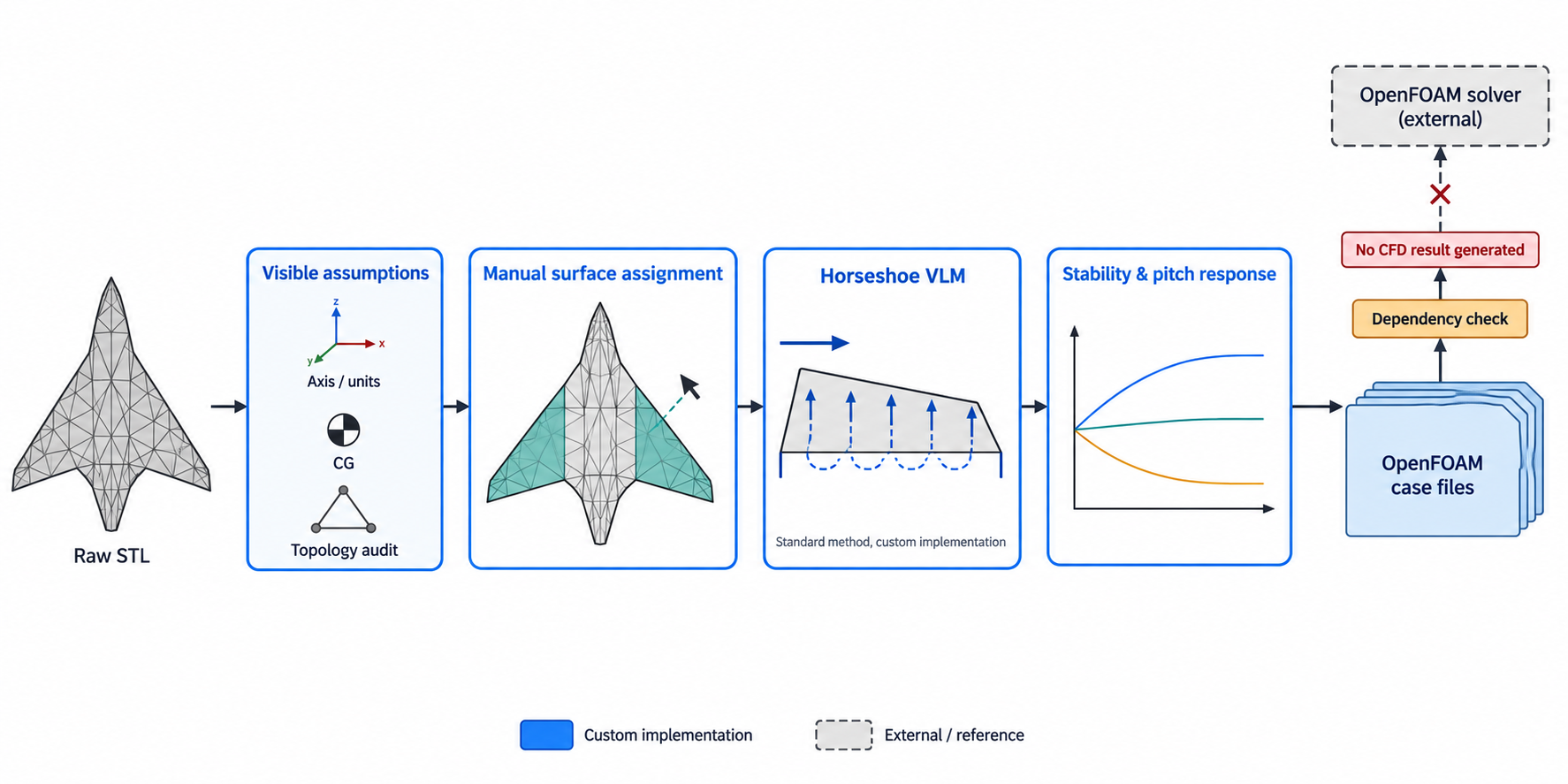
The workflow begins with units, axes, mass, center of gravity, topology, and manual surface selection. A custom horseshoe Vortex Lattice Method (VLM) implementation then estimates aerodynamic forces and longitudinal stability quantities. The same reference conventions can be exported into an OpenFOAM case for subsequent CFD work.
Implementation and preliminary checks
The workbench combines geometry processing, lifting-surface extraction, and numerical diagnostics in a Three.js interface. The solver uses standard quarter-chord bound vortices, three-quarter-chord collocation, Biot–Savart influence calculations, and Kutta–Joukowski forces. These are established numerical methods; XFLR5 is a reference, while OpenFOAM remains a separate external solver.
In controlled rectangular-wing tests, the lift slope fell within a 16% tolerance of lifting-line theory, and the linear-system residual was below 10−7. The induced-drag tests showed the expected quadratic trend. These are preliminary implementation checks; a closer comparison against established aerodynamic solvers remains necessary. An inviscid VLM also cannot establish stall behavior.
Current development stage
The browser MVP generates OpenFOAM case files, including mesh and solver configuration. No OpenFOAM mesh or CFD simulation has been executed, so there is no CFD result to report. The next substantive step is to run a suitable case, inspect mesh quality, and compare the resulting forces with the VLM estimates.
The collaboration is independent of official institutional sponsorship. Third-party demonstration geometry is not included in this portfolio.