Research & engineering
Speech-Driven Avatar Systems
Collaborative speech-to-avatar integration, streaming, and GPU deployment at MILab.
Deployed engineering system. Collaborative work with Niloy; research-manuscript direction under exploration.
From conversational speech to a visual response
At North South University’s Machine Intelligence Lab (MILab), I work on speech-driven avatars through applied research and industry collaboration. My colleague Niloy and I have developed, deployed, and evaluated a custom PersonaPlex–IMTalker pipeline on NVIDIA Jetson AGX Orin. We are now exploring a research-manuscript direction based on this engineering work.
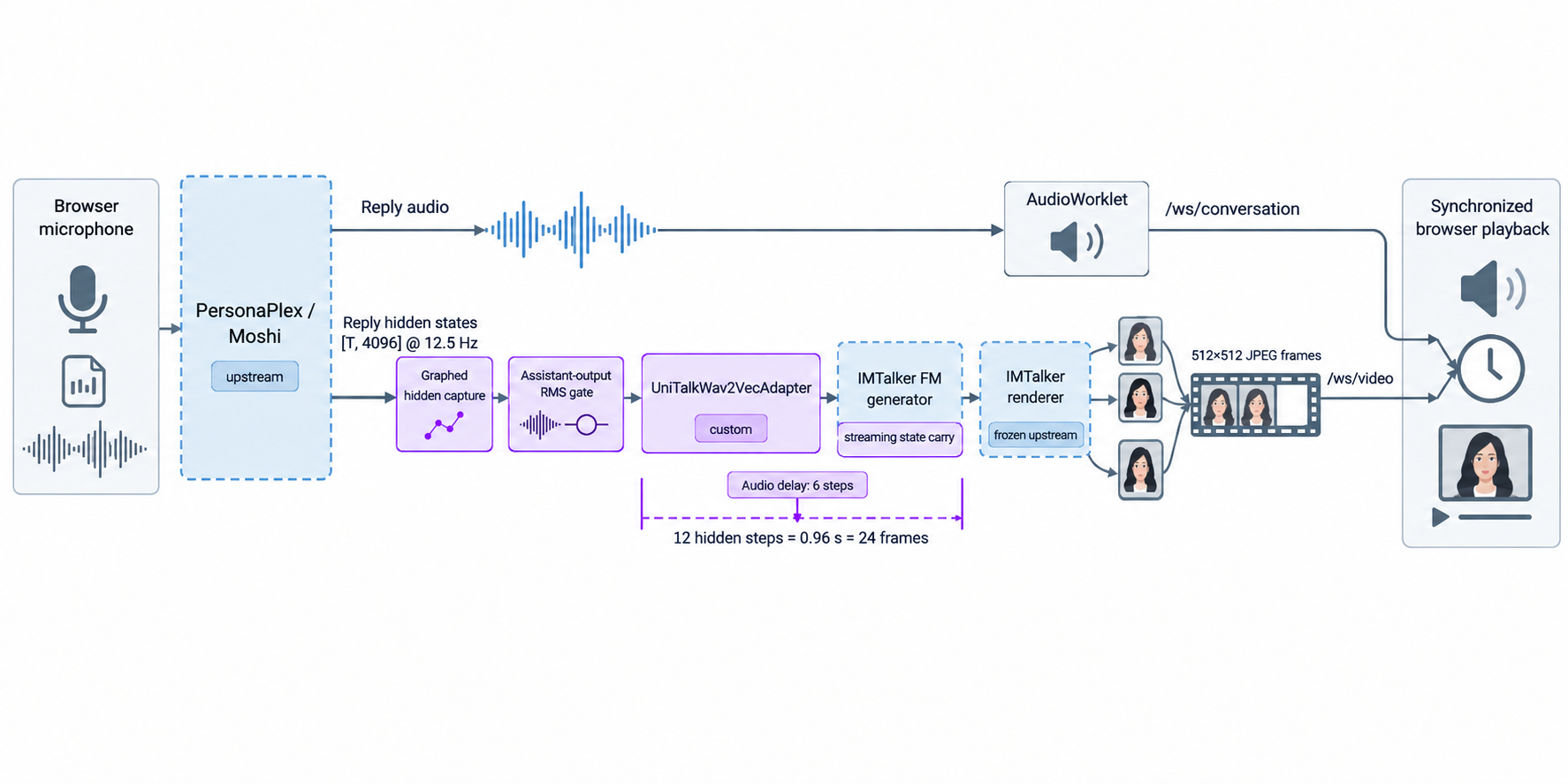
The systems connect conversational speech generation to facial motion and rendering while managing streaming, interruptions, and browser audio/video synchronization. The wider collaboration includes representation adapters, renderer studies and distillation, TensorRT acceleration, and profiling across server GPUs and Jetson hardware. My individual work includes distributed multi-GPU inference pipelines and an investigation of NVIDIA Audio2Face–Three.js integration and ARKit blendshape recovery.
We build on external models and pretrained checkpoints, including Moshi, PersonaPlex, IMTalker, MuseTalk, F5-TTS, Wav2Vec2, and GaussianTalker. Our work concerns how these components are adapted, connected, and evaluated under deployment constraints.
Renderer speed and system performance
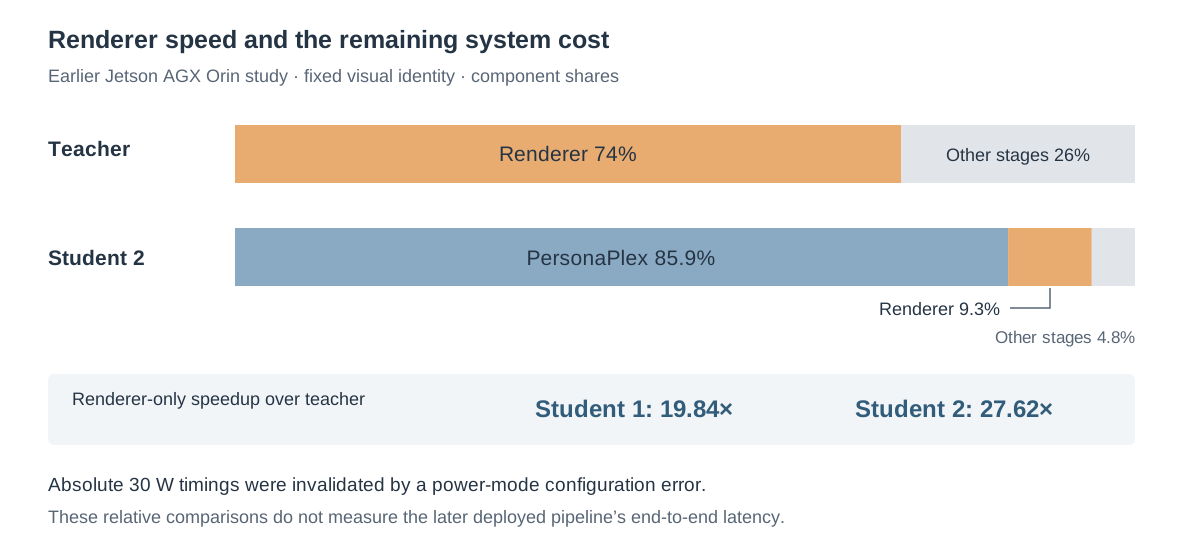
Accelerating the renderer changed where the system spent its time. In an earlier fixed-identity Orin comparison, two distilled renderers were 19.84× and 27.62× faster than their teacher, shifting the dominant cost toward PersonaPlex. A power-mode configuration error invalidated the absolute timings attributed to 30 W in that study; the relative component comparison remains informative.
Later deployed-pipeline logs report approximately 66–67 ms per processing step on Orin. This is a runtime step measurement, not a measurement of the delay a user experiences between speaking and seeing a synchronized response. Long-session lag and client-side A/V alignment still need systematic evaluation. The current renderer studies also use a single visual identity, so they do not establish generalization across identities.
Questions for the next phase
Deployment has made timing and evaluation central research questions: which speech information is available soon enough to drive articulation, and how should we measure a renderer that must respond continuously? Matching a teacher’s output does not by itself establish convincing articulation or a usable conversation.
We are developing these questions into a possible manuscript direction. The integration and deployment are completed engineering work; the proposed research claims require further experiments. A separate StreamTalker-GS investigation tested a covariance-transport hypothesis that I set aside after negative findings. Portions of the industry collaboration remain closed source.